
August 13, 2026
Architectural Trends in West Africa: Between Modernity, Identity and Climate Adaptation
Architecture in West Africa is evolving rapidly. In Ouagadougou, Abidjan, Dakar, Accra, Cotonou and Lagos, contemporary buildings increasingly combine modern aesthetics, local materials, thermal comfort and cultural identity. Beyond visual trends, a new approach is emerging: designing buildings that are genuinely adapted to their environment and the needs of their occupants.
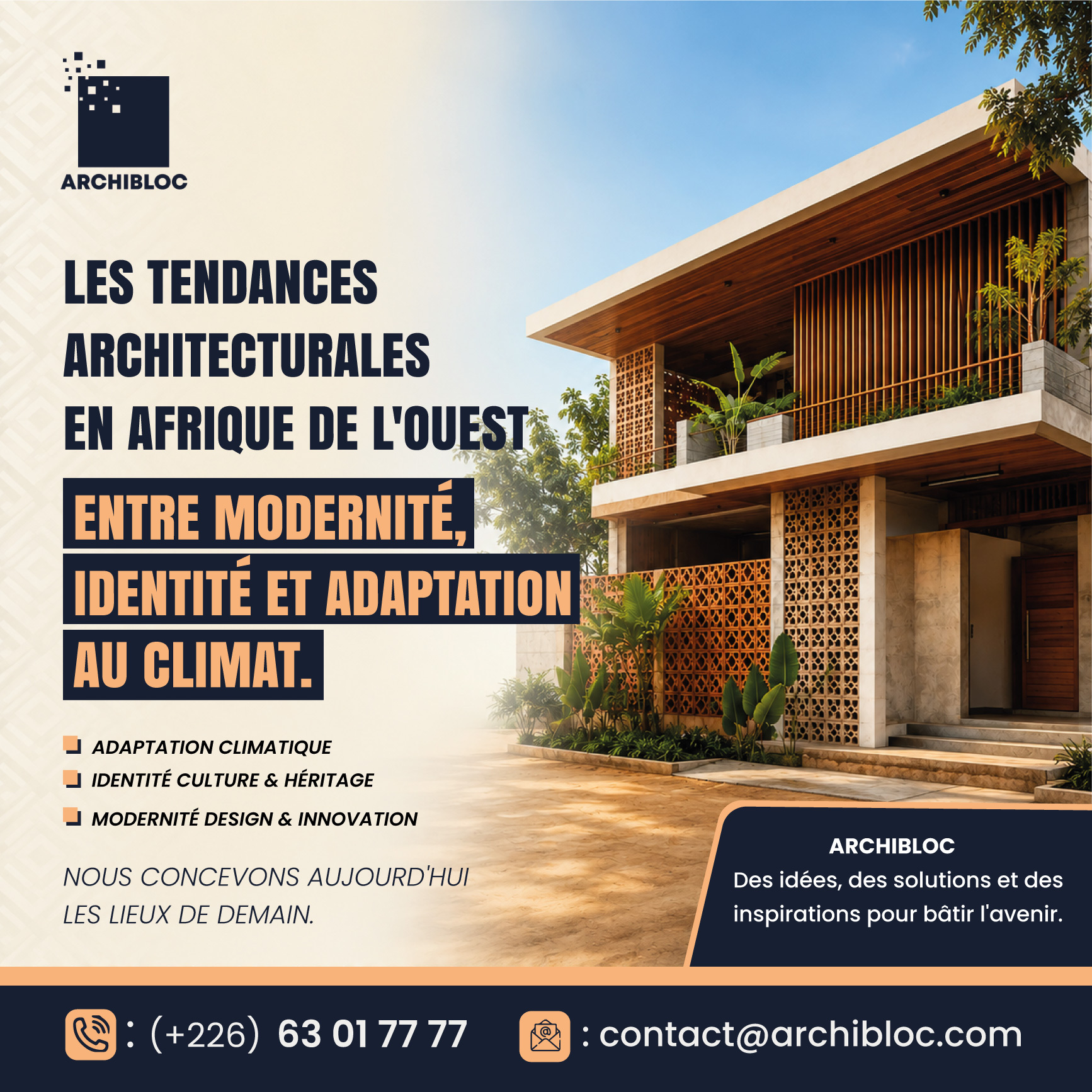
Modern Architecture Rooted in Its Territory
For many years, architectural modernity in West Africa was often associated with imported forms, materials and design models. Today, this approach is changing. Architects are increasingly seeking to develop a contemporary African architecture that incorporates international standards while preserving a strong local identity.
Clean façades, geometric volumes, large openings, terraces and outdoor spaces are being combined with elements inspired by traditional architecture: courtyards, screens, solar protection, earth-based materials and transitional spaces between indoors and outdoors.
The result is modern architecture that remains connected to its environment.
1. The Return of Local Materials
The use of locally available materials is one of the most interesting trends in contemporary West African architecture.
Compressed earth blocks, laterite, stone, wood and certain plant-based materials are increasingly being reinterpreted in modern construction projects. The goal is not necessarily to reproduce traditional construction techniques exactly, but rather to combine them with modern engineering and construction methods.
Projects across Senegal, Ghana and Côte d'Ivoire demonstrate how earth-based materials can be incorporated into contemporary buildings while addressing environmental and climatic challenges.
This approach can offer several advantages:
potentially reduced transportation of certain materials;
better visual integration with the local landscape;
preservation and development of local know-how;
construction solutions better adapted to the climate.
However, using a local material does not automatically make a building sustainable. The overall design and construction strategy remain critical.
2. Bioclimatic Architecture Is Becoming Essential
In much of West Africa, heat is one of the major challenges affecting indoor comfort. Contemporary architecture is therefore increasingly focusing on passive cooling strategies.
Before relying heavily on air conditioning, architects can address thermal comfort from the earliest design stages through:
building orientation;
natural ventilation;
solar shading;
roof overhangs;
courtyards and shaded areas;
vegetation;
appropriate material selection;
roof insulation.
Solar screens and filtered façades are particularly effective because they reduce direct solar exposure while maintaining natural light and openness.
The roof also deserves particular attention. Research on residential building typologies in Ghana and Senegal has shown that roof insulation can significantly reduce the energy required to operate buildings.
3. Outdoor Spaces Are Becoming an Extension of the Home
Another strong trend is the gradual disappearance of the traditional boundary between indoor and outdoor spaces.
Covered terraces, courtyards, interior gardens, pergolas and large glazed openings create additional living areas while encouraging natural ventilation and daylight.
In the West African context, this approach is particularly relevant. A well-designed outdoor area can become a genuine extension of the living room, rather than simply a decorative feature.
This is especially valuable in residential architecture, where shaded outdoor spaces can provide comfortable areas for relaxation, family gatherings and social activities.
4. Minimalism Meets African Design
Contemporary minimalism — characterized by clean lines, simple volumes and neutral colour palettes — is becoming increasingly popular in residential and commercial projects.
But minimalism does not necessarily mean cold or impersonal architecture.
More projects are incorporating:
natural textures;
colours inspired by the local environment;
African patterns;
local craftsmanship;
wood and stone;
locally produced decorative elements.
The objective is to create architecture that is simple yet distinctive, where cultural identity becomes part of the design rather than merely an added decoration.
5. Smarter and More Efficient Buildings
The transformation is not limited to the appearance of buildings.
West African architecture is also moving toward buildings that manage energy, water and resources more efficiently.
Increasingly, projects integrate:
photovoltaic solar panels;
LED lighting;
rainwater management and harvesting systems;
energy-efficient equipment;
security and monitoring systems;
smart-home technologies.
The objective is straightforward: reduce operating costs while improving comfort and functionality.
For countries facing high temperatures, growing energy demand and rapid urbanization, energy-efficient design is becoming an economic necessity as much as an environmental consideration.
6. Building More Densely Without Sacrificing Quality
Rapid urbanization in major West African cities is also forcing professionals to rethink how land is used.
Single-family homes remain highly popular, but vertical residential projects, mixed-use buildings and collective housing are becoming increasingly relevant in areas experiencing strong land pressure.
Higher density can be an opportunity when supported by intelligent design. Shared spaces, natural ventilation, daylight, vegetation and access to essential services should be considered from the earliest stages of the project.
The challenge is therefore not simply to build more, but to build better within limited urban space.
Towards a New West African Architectural Identity
The real underlying trend is therefore not simply “building modern.”
It is about building modern, but building appropriately.
A high-performing building in West Africa must respond to its climate, materials, environment, users and cultural context.
The architecture of tomorrow will probably be neither a copy of Western architecture nor a simple return to traditional construction. It will be hybrid, contemporary, local and climate-responsive.
This intersection between architecture, engineering and local context represents one of the major opportunities for the construction sector across West Africa.
ARCHIBLOC: Building Excellence, One Stone at a Time
At ARCHIBLOC, we believe that a successful project must go beyond aesthetics. Design must respond to the site, climate, budget and future use of the building.
Architecture • Engineering • Construction • Renovation
Planning a construction project in Burkina Faso or elsewhere in West Africa? Good design is the first investment in a successful project.